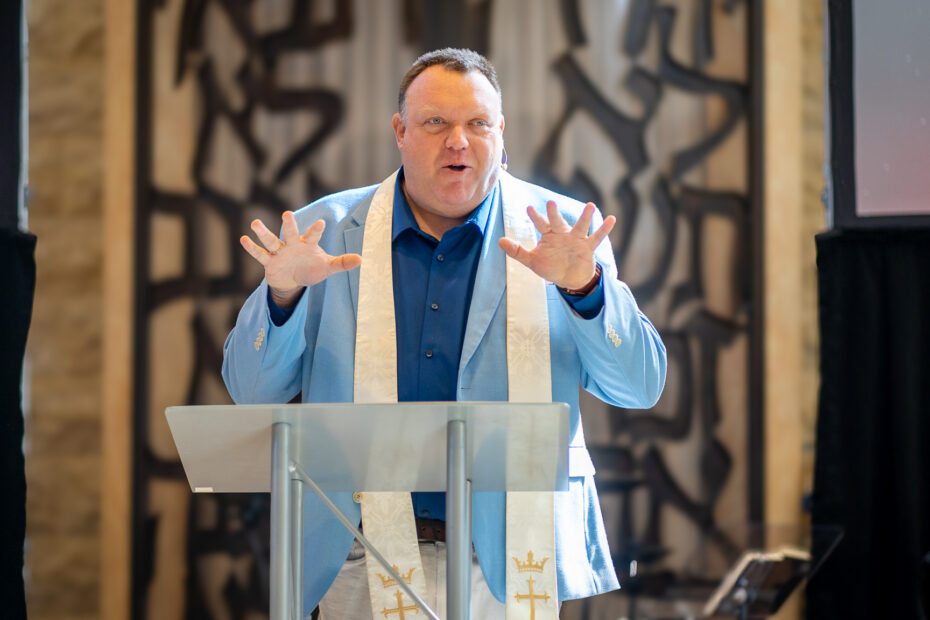
There are moments in the church year when I find myself pausing and asking a simple question: How is your Lent going?
Maybe you started strong on Ash Wednesday. Maybe you downloaded the devotional. Maybe you committed to prayer, reflection, or giving something up. But now we’re in the middle of the journey—the third Sunday of Lent—and this is often the point when the excitement fades and the honest questions begin.
So let me ask you personally:
How is your Lent going?
Have the practices you began actually helped you slow down and make space for God?
Because that’s really what Lent is about. It’s about clearing space in our crowded lives so we can hear God again. It’s about quieting the noise long enough to listen for the whisper of the Holy Spirit.
And sometimes, the middle of the journey is the perfect time to pause, reassess, and begin again.
A Moment to Recenter
One of the reasons I value gathering in worship is because it reminds me of something I forget all week long:
I am not the center of the universe.
When we worship, we remember that we have a Creator, a Sustainer, and a Savior who is worthy of our attention and devotion.
And once our hearts are centered again, we become more open to what God might be saying to us.
So before we go any further, let’s ask God for that openness.
Prayer Reflection
God, we come before you grateful for the many blessings we’ve experienced.
Yet our lives are often full—full of noise, responsibility, distraction.
Help us make space to hear you again.
Teach us to trust you, obey you, and follow where you lead.
Amen.
The Spiritual Practice We Rarely Talk About
Today I want to talk about something that Jesus assumed His followers would practice, but something we rarely discuss in the modern church.
Fasting.
Listen to Jesus’ words in Matthew 6:
“When you fast, do not look somber like the hypocrites… But when you fast, put oil on your head and wash your face, so that your fasting may not be seen by others, but by your Father who is in secret.”
Did you notice the wording?
Jesus doesn’t say “if you fast.”
He says “when you fast.”
In the Sermon on the Mount, Jesus highlights three spiritual practices that shape our relationship with God:
- Giving
- Prayer
- Fasting
Yet if we’re honest, fasting is probably the least practiced discipline in American Christianity.
We talk about prayer.
We encourage generosity.
But fasting?
That one makes us uncomfortable.
What Fasting Really Is
Let me describe fasting in the simplest way I can:
Fasting is an intentional hunger for God.
Jesus once said:
“Blessed are those who hunger and thirst for righteousness, for they shall be filled.”
But if we’re honest, many of us are hungering for other things.
Security.
Success.
Comfort.
Approval.
Fasting helps us reorder our hunger.
When we intentionally step away from something—often food—we begin to notice what our hearts truly depend on.
And that’s where the real work begins.
What Hunger Reveals
You’ve probably heard the phrase “hangry.”
Miss a meal and suddenly your patience disappears.
Why?
Because hunger exposes what’s inside us.
Fasting works the same way spiritually.
When we remove something we normally rely on—food, comfort, distractions—we start to notice what our hearts cling to.
The spiritual writer Richard Foster once said:
Fasting reminds us that we are sustained not by bread alone but by every word that comes from the mouth of God.
Fasting exposes the things competing for our attention.
And it gently redirects our dependence back to God.
Fasting in the Story of Scripture
Once you start looking for fasting in the Bible, you realize it’s everywhere.
- Moses fasted on Mount Sinai before receiving the Ten Commandments.
- Elijah fasted in the wilderness while seeking God’s direction.
- Esther called the people to fast before approaching the king to save her people.
- The people of Nineveh fasted when they repented after hearing Jonah’s message.
- Jesus fasted forty days before beginning His public ministry.
Notice the pattern.
Fasting often comes before something important.
Before revelation.
Before repentance.
Before mission.
Before breakthrough.
And that raises an important question for us.
What if the breakthrough we’re praying for is connected to a discipline we’ve forgotten?
A Lesson From the Early Church
The early church took fasting seriously.
One of the earliest Christian documents, called the Didache (written around 100 AD), instructed believers to fast every Wednesday and Friday.
- Wednesday remembered the day Judas betrayed Jesus.
- Friday remembered the crucifixion.
For them, fasting wasn’t unusual.
It was normal.
What I Learned From Christians Who Had Nothing
Some of the people who most deeply shaped my understanding of fasting were Christians from Eastern Europe—places like Estonia, Ukraine, and Russia.
Many of them lived under Soviet oppression.
They couldn’t protest publicly.
They couldn’t challenge leaders openly.
So what did they do?
They fasted and prayed.
They believed that if they couldn’t change the system outwardly, they could cry out to God inwardly.
They fasted for breakthrough.
And they believed God heard them.
Watching their faith changed how I think about spiritual disciplines.
A Mid-Lent Invitation
So here we are in the middle of Lent.
And maybe you’re thinking:
I didn’t start strong.
I’ve already fallen off track.
That’s okay.
Lent isn’t about perfection.
It’s about returning.
And today might simply be an invitation to begin again.
Questions for Reflection
Take a few moments and reflect honestly:
- How has your Lent been going so far?
- Have your spiritual practices made space for God, or just filled your schedule?
- What might God be inviting you to fast from—not just food, but distractions, comforts, or habits?
- What breakthrough are you asking God for right now?
Sometimes the very thing we resist is the doorway to deeper dependence on God.
A Simple Practice to Try
If fasting is new for you, start small.
Consider one of these:
- Skip one meal and use that time for prayer.
- Fast from social media for a day.
- Fast from constant noise—music, podcasts, news—and create quiet space.
Each time you feel the absence, turn it into prayer.
Let the hunger remind you:
God is my true source.
Moving Toward Resurrection
One of the beautiful things about Lent is that even in the wilderness, we know where the journey leads.
Every Sunday reminds us:
Resurrection is coming.
So wherever you are in your Lent journey today—strong or struggling—remember this:
It’s not too late to make room for God.
And sometimes the path back begins with something as simple as hunger.